
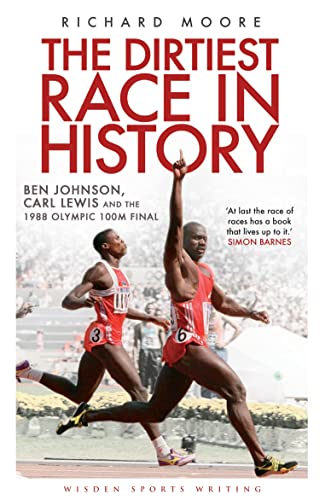
The Dirtiest Race in History English
Material type: TextSeries: Publication details: New Delhi Bloomsbury Publishing 2013Edition: FirstDescription: 336ISBN:
 - 9781408158760
- English
- 796 MOO 796 MOO
 Books
Books
| Item type | Home library | Call number | Status | Date due | Barcode | Item holds | |
|---|---|---|---|---|---|---|---|
|
Books
|
PARCO Chapter (Main Library - Central Region) | 796 MOO (Browse shelf(Opens below)) | Available | 2025-38041049 |
• Title: The Dirtiest Race in History: Ben Johnson, Carl Lewis and the 1988 Olympic 100m Final • Author: Richard Moore • First published: 2013 (Paperback edition) • Pages: 336 • Genre: Non-fiction / sports history / investigative journalism. • What the Book Covers • The book recounts the events of the men’s 100 metres final at the 1988 Summer Olympics in Seoul — a race regarded by many as “the dirtiest race in history.” • On race day, Ben Johnson won with a world-record time of 9.79 seconds. • The triumph, however, was short-lived: shortly after the race Johnson tested positive for a banned steroid (stanozolol), and his gold medal and world record were stripped. • The gold was then awarded to Carl Lewis; the silver went to Linford Christie; and bronze to Calvin Smith. • But the scandal didn’t end there. Over time, other top finishers — and even some athletes outside the top three — came under suspicion or were found to have used performance-enhancing drugs. Themes, Analysis & Impact • Doping and corruption in elite sport: The book lays bare how widespread doping was among top sprinters at the time — not just an isolated offender, but a systemic issue affecting multiple medalists. • Rivalry, fame and moral conflict: Moore paints a vivid contrast between the main rivals — Carl Lewis and Ben Johnson — not only as athletes, but as very different personalities: one graceful and media-savvy, the other raw, powerful, troubled. • Sport vs spectacle: The race becomes a symbol of the tension between the purity of competition and the temptation of success at any cost — raising questions about fairness, legacy, and the price of glory. • Aftermath and legacy: Moore doesn’t just focus on the race. He tracks what happened afterward — how some careers and reputations survived, others collapsed — showing lasting consequences for athletics, scrutiny and trust in sports records.
There are no comments on this title.